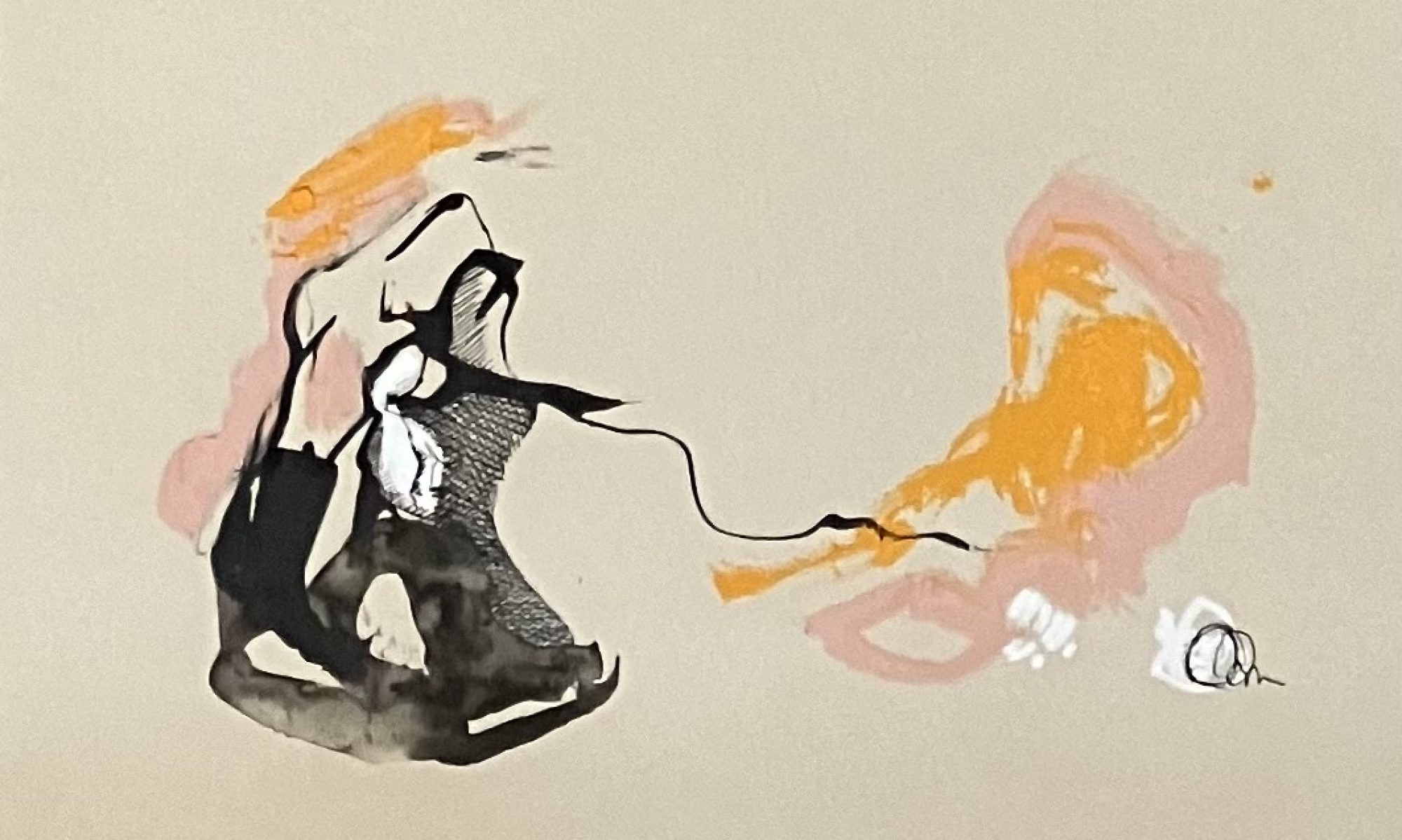
World in Turmoil (De wereld in beroering)
To enter the room is to find books set loose from every shelf that ever held them. Suspended on fine threads beneath bare, burning bulbs, old volumes hang in the air at eye level, opened, splayed, pierced, some fanning their pages like wings caught mid-beat, others driven through with long screws as if fixed to an invisible wall. The space around them is stripped and plain, a dark board floor, a single white radiator, and against that austerity each book throws a heavy, almost human shadow, so that the room fills quietly with presences.
Her source material is a mid-century Dutch survey of Renaissance art, a book about how art and the very figure of the artist first claimed their place in the world. Simons does not treat it gently. On one page she has painted out nearly everything, blacking the text until only a handful of words are left alive, and those surviving words form a poem: de wereld, de wereld in beroering, scheppend door gedachte of woord, als intense aanraking worden deze onherroepelijk verbonden. The world. The world in turmoil. Created through thought or word, as an intense touch, these become irrevocably bound. It is from this recovered fragment that the work takes its name.
Here technique and meaning are inseparable, because what she does to the book she does in full view: she blacks out, she cuts, she pierces, she lets fall. Whole sentences have been sliced from the pages into thin strips and allowed to drop, pulled down by threads of orange-red that run from the hanging books to the floor, where the words collect in a tangled, chaotic heap. Those red threads are the nerve of the piece. They read at once as bloodlines and as veins, as the thread of a narrative and as the last fragile link still tying the scattered words back to the book they fell from. One strip hangs alone in its descent, and on it a single question survives: behoeft het nog eens herhaald, does it need to be said again.
What this does to the viewer is physical before it is intellectual. You lower your voice. You move carefully around the floating pages the way you would around sleeping birds, or around something wounded. The light is bare and faintly interrogative, the shadows loom, and the strange beauty of a screw driven clean through a book is something you feel in the body before you explain it to yourself. And yet nothing here is merely destructive. The cutting is done with a jeweller’s care, the fallen words are laid down as tenderly as they are scattered, and the whole room hums with attention rather than anger.
The message that comes across is generous and open rather than closed. Simons takes the grand, settled story of art history, a narrative of order, mastery and fame, and quite literally takes it apart, returning its certainties to turmoil. But the found poem at its heart insists on something hopeful inside that upheaval: that thought and word still create, that touch still binds, that even severed and strewn across the floor the words remain joined by a thread. This is a work about how meaning is unmade and remade, about what we choose to black out and what we choose to keep, and about the fragile, stubborn lines that hold a broken story together. It is conceptually sharp and quietly moving in the same breath, and it stays with you long after you have left the room